
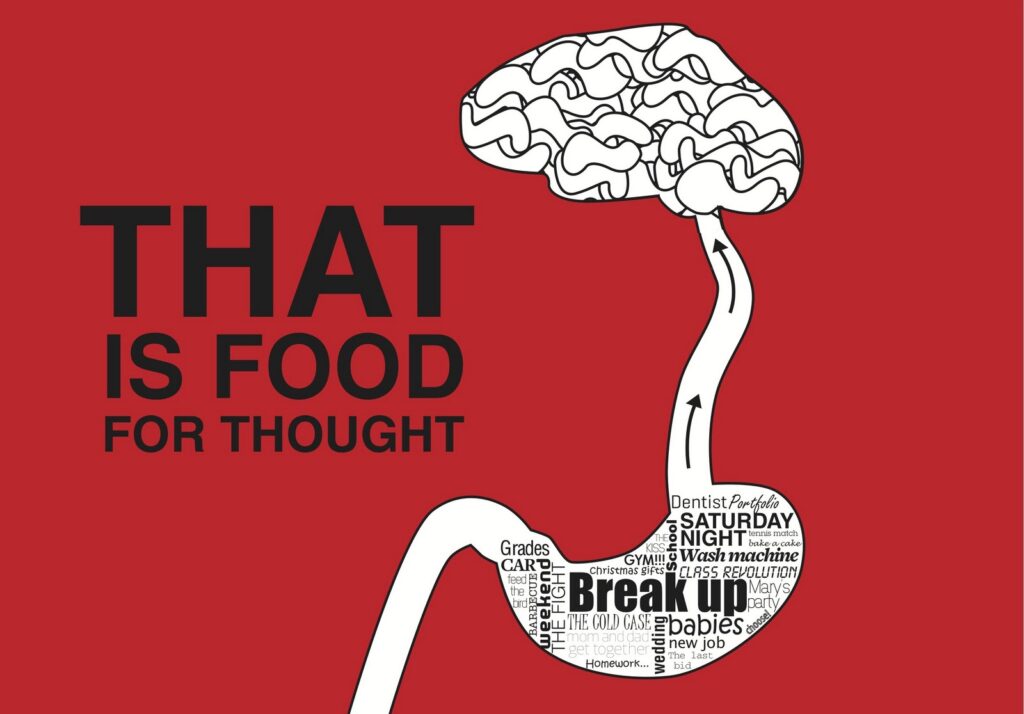
Let us reflect on the concept of thinking, how do we define thinking? We can look at thinking as the act of generating immaterial mental projections of designed functions that occur only conceptually.
So basically, thinking is the immaterial action done by our brain, but that begs the question, is thinking an exercise? Do different thinking processes result in the enlargement and strengthening of different “mental muscles”?
We can see this when we absorb the different types of cognitive supplements that come from two titans of modern science: Math and Physics.
Let’s go in deep to the supplements given by these sciences, let’s start with Math, as we write equations, as we draw 2-dimensional, 1-dimensional and zero dimensional figures, one question comes to mind, how do we even think of this?
The world is a 3-dimensional space, we can only see 2 dimensional figures and an apparent third dimension due to the parallax effect, for us to actually see one dimensional or lower figures we would need an infinite shrinkage of the extra dimensional extensions, which in itself is physically impossible to visualize, because an actual line, something with no breath just length, would not be visible for us, we can even see that the more we reduce the breath of a wire, the more invisible it becomes to us, the same goes for zero dimensional figures (points).
So, whenever we draw a square, we cannot call it a square, because, although small, the lines we draw forming the square have length but an incredibly small width and an even smaller height, because the graphite or any other material used is 3-dimensional.
So in our world, we have no physical way to create, see, or even fathom how such a figure would look, the only place where we could theoretically see a perfect zero-dimensional figure is in the centre of a black hole.
But how is it possible? Math perfectly explains and describes things that are unattainable to our minds but become malleable thanks to it, it begs the question, how is this possible? Isn’t math something that comes from mental activity?
This is a rather complex question, but the one we are interested in answering from this same question is the following: What mental muscle is engaged by math? We can call that muscle the abstractive muscle, but not in the sense most people associate with it, but in the sense that it strengthens your ability to interpret things that you cannot see or even imagine about.
Now, let’s talk about the possible mental muscle stimulated by Physics, Physics teach us everything there is to know regarding the material world, there is nothing in physics we can’t in a way fathom or interpret, even things like x rays or other things invisible to the human eye, we are still able to at least analyse the consequences that prove their existence, we can even in a way see them if innovative machinery is equipped, so physics is in our domain.
We can see that physics is something that gives us a stimulation about things we usually see every day, but that stimulation makes us only re-think about our initial assessment of the same object, so really, the new things that physics adds to our mind is of things that were always present in the universe, sort of like the opposite of math, but ironically physics uses math, that explains the non-existent, as a benchmark to explain all that exists.
So, what type of mental muscle is stimulated by pursuing physics? We can say that it is the reflective muscle.
Some might argue that the reflective muscle is stimulated by math as well but I would refute that, because you cannot reflect upon things you could never think about in the first place, a new type of stimulation has to be considered for math, but for physics, everything is material, can be tampered or at least conceivable in a manner, so you have the ability to think about them when encountering them, and if repeated thinking and mental rearranging is done while trying to mentally decipher them, there is no better muscle that is stimulated than the reflective muscle.
So, to conclude, the impact that math and physics have for all thinkers is that they better their capability of abstraction and of reflection respectively.